We live in an exciting era for extragalactic astrophysics. Precision cosmology has established the broad framework in which galaxies form, while facilities such as JWST, ALMA, VLT/MOONS and, soon, the ELT are transforming our view of galaxies across cosmic time. Yet we still lack a complete physical picture of how galaxies assemble, form stars, grow black holes, enrich their gas, and evolve into the diverse population observed today.
Our group, led by Prof. Roberto Maiolino and Dr. Sandro Tacchella, combines observations, theory and modelling to study galaxy formation and evolution from the first billion years after the Big Bang to the present day. We work on the earliest galaxies revealed by JWST, the growth and impact of supermassive black holes, star formation and quenching, chemical enrichment, galaxy dynamics, and the role of environment.
We have world-leading expertise in optical, near-infrared and sub-millimetre observations, including integral-field spectroscopy and ALMA interferometry. We are also strongly involved in major current and future facilities and surveys, including JWST, VLT/MOONS, ELT/ANDES and related large programmes. Our theoretical and modelling work helps interpret these data and guides new observational projects.
To find out more, please explore our recent publications and research themes.
Our group gratefully acknowledges support from STFC, the Royal Society, the European Research Council and other national and international funding bodies.
The Extragalactic Astrophysics Research Group is based at the Kavli Institute for Cosmology and in the Battcock Centre for Experimental Astrophysics, which are located close to the Institute of Astronomy off the Madingley Road to the west of Cambridge city centre.
The Kavli Institute for Cosmology (KICC) brings together astrophysicists from the Cavendish Laboratory, the Institute of Astronomy (IoA), and the Department of Applied Mathematics and Theoretical Physics (DAMTP) — all at one site. Strategically co-locating expertise in experimental, theoretical, and observational astronomy, the KICC fosters collaboration in cosmology and galaxy formation. With its modern design and shared spaces, it has rapidly become the beating heart of Cambridge’s astronomy community, inspiring innovation and cohesion across the department.
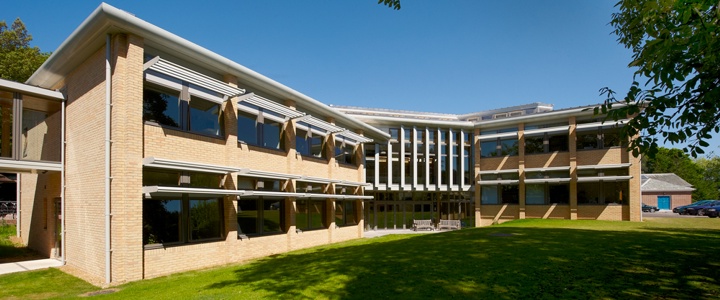
Kavli Institute for Cosmology, Cambridge (KICC)